Ownership is Rust’s most unique feature and has deep implications for the rest of the language. It enables Rust to make memory safety guarantees without needing a garbage collector, so it’s important to understand how ownership works. In this chapter, we’ll talk about ownership as well as several related features: borrowing, slices, and how Rust lays data out in memory.
Ownership is a set of rules that govern how a Rust program manages memory. All programs have to manage the way they use a computer’s memory while running. Some languages have garbage collection that regularly looks for no-longer-used memory as the program runs; in other languages, the programmer must explicitly allocate and free the memory. Rust uses a third approach: memory is managed through a system of ownership with a set of rules that the compiler checks. If any of the rules are violated, the program won’t compile. None of the features of ownership will slow down your program while it’s running.
Because ownership is a new concept for many programmers, it does take some time to get used to. The good news is that the more experienced you become with Rust and the rules of the ownership system, the easier you’ll find it to naturally develop code that is safe and efficient. Keep at it!
When you understand ownership, you’ll have a solid foundation for understanding the features that make Rust unique.
Ownership Rules
- Each value in Rust has an owner.
- There can only be one owner at a time.
- When the owner goes out of scope, the value will be dropped.
Memory and Allocation
In the case of a string literal, we know the contents at compile time, so the text is hardcoded directly into the final executable. This is why string literals are fast and efficient. But these properties only come from the string literal’s immutability. Unfortunately, we can’t put a blob of memory into the binary for each piece of text whose size is unknown at compile time and whose size might change while running the program.
With the String type, in order to support a mutable, growable piece of text, we need to allocate an amount of memory on the heap, unknown at compile time, to hold the contents. This means:
- The memory must be requested from the memory allocator at runtime.
- We need a way of returning this memory to the allocator when we’re done with our
String.
That first part is done by us: when we call String::from, its implementation requests the memory it needs. This is pretty much universal in programming languages.
However, the second part is different. In languages with a garbage collector (GC), the GC keeps track of and cleans up memory that isn’t being used anymore, and we don’t need to think about it. In most languages without a GC, it’s our responsibility to identify when memory is no longer being used and to call code to explicitly free it, just as we did to request it. Doing this correctly has historically been a difficult programming problem. If we forget, we’ll waste memory. If we do it too early, we’ll have an invalid variable. If we do it twice, that’s a bug too. We need to pair exactly one allocate with exactly one free.
Rust takes a different path: the memory is automatically returned once the variable that owns it goes out of scope. Here’s a version of our scope example from Listing 4-1 using a String instead of a string literal:
fn main() {
    {
        let s = String::from("hello"); // s is valid from this point forward
        // do stuff with s
    }                                  // this scope is now over, and s is no
                                       // longer valid
}
There is a natural point at which we can return the memory our String needs to the allocator: when s goes out of scope. When a variable goes out of scope, Rust calls a special function for us. This function is called drop, and it’s where the author of String can put the code to return the memory. Rust calls drop automatically at the closing curly bracket.
Note: In C++, this pattern of deallocating resources at the end of an item’s lifetime is sometimes called Resource Acquisition Is Initialization (RAII). The
dropfunction in Rust will be familiar to you if you’ve used RAII patterns.
This pattern has a profound impact on the way Rust code is written. It may seem simple right now, but the behavior of code can be unexpected in more complicated situations when we want to have multiple variables use the data we’ve allocated on the heap. Let’s explore some of those situations now.
Variables and Data Interacting
Move
let s1 = String::from("hello");
let s2 = s1;
The concept of copying the pointer, length, and capacity without copying the data probably sounds like making a shallow copy. But because Rust also invalidates the first variable, instead of being called a shallow copy, it’s known as a move. In this example, we would say that s1 was moved into s2.
Clone
If we do want to deeply copy the heap data of the String, not just the stack data, we can use a common method called clone. We’ll discuss method syntax in Chapter 5, but because methods are a common feature in many programming languages, you’ve probably seen them before.
Here’s an example of the clone method in action:
fn main() {
    let s1 = String::from("hello");
    let s2 = s1.clone();

    println!("s1 = {}, s2 = {}", s1, s2);
}Notice: The data stored in stack are copied by default. The reason is that types such as integers that have a known size at compile time are stored entirely on the stack, so copies of the actual values are quick to make. That means there’s no reason we would want to prevent x from being valid after we create the variable y. In other words, there’s no difference between deep and shallow copying here, so calling clone wouldn’t do anything different from the usual shallow copying, and we can leave it out.
Rust has a special annotation called the
Copytrait that we can place on types that are stored on the stack, as integers are (we’ll talk more about traits in Chapter 10). If a type implements theCopytrait, variables that use it do not move, but rather are trivially copied, making them still valid after assignment to another variable.
Rust won’t let us annotate a type with
Copyif the type, or any of its parts, has implemented theDroptrait. If the type needs something special to happen when the value goes out of scope and we add theCopyannotation to that type, we’ll get a compile-time error. To learn about how to add theCopyannotation to your type to implement the trait, see “Derivable Traits” in Appendix C.
So, what types implement the
Copytrait? You can check the documentation for the given type to be sure, but as a general rule, any group of simple scalar values can implementCopy, and nothing that requires allocation or is some form of resource can implementCopy. Here are some of the types that implementCopy:
- All the integer types, such as
u32. - The Boolean type,
bool, with valuestrueandfalse. - All the floating-point types, such as
f64. - The character type,
char. - Tuples, if they only contain types that also implement
Copy. For example,(i32, i32)implementsCopy, but(i32, String)does not.
Ownership and Functions
The mechanics of passing a value to a function are similar to those when assigning a value to a variable. Passing a variable to a function will move or copy, just as assignment does. The following code is an example with some annotations showing where variables go into and out of scope.
fn main() {
    let s = String::from("hello");  // s comes into scope

    takes_ownership(s);             // s's value moves into the function...
                                    // ... and so is no longer valid here

    let x = 5;                      // x comes into scope

    makes_copy(x);                  // x would move into the function,
                                    // but i32 is Copy, so it's okay to still
                                    // use x afterward

} // Here, x goes out of scope, then s. But because s's value was moved, nothing
  // special happens.

fn takes_ownership(some_string: String) { // some_string comes into scope
    println!("{}", some_string);
} // Here, some_string goes out of scope and `drop` is called. The backing
  // memory is freed.

fn makes_copy(some_integer: i32) { // some_integer comes into scope
    println!("{}", some_integer);
} // Here, some_integer goes out of scope. Nothing special happens.
If we tried to use s after the call to takes_ownership, Rust would throw a compile-time error. These static checks protect us from mistakes. Try adding code to main that uses s and x to see where you can use them and where the ownership rules prevent you from doing so.
Returning values can also transfer ownership.
Reference & Borrowing
Concept
The way to avoid repeated ownership transferring is Reference, which is the same as C++.
Note: The opposite of referencing by using
&is dereferencing, which is accomplished with the dereference operator,*. We’ll see some uses of the dereference operator in Chapter 8 and discuss details of dereferencing in Chapter 15.
We call the action of creating a reference borrowing. As in real life, if a person owns something, you can borrow it from them. When you’re done, you have to give it back. You don’t own it.
That means all the reference in rust is actually const reference by default.
But we can add mut keyword to mutable reference, example:
fn main() {
    let mut s = String::from("hello");

    change(&mut s);
}

fn change(some_string: &mut String) {
    some_string.push_str(", world");
}
Mutable references have one big restriction: if you have a mutable reference to a value, you can have no other references to that value.
The restriction preventing multiple mutable references to the same data at the same time allows for mutation but in a very controlled fashion. It’s something that new Rustaceans struggle with because most languages let you mutate whenever you’d like. The benefit of having this restriction is that Rust can prevent data races at compile time. A data race is similar to a race condition and happens when these three behaviors occur:
- Two or more pointers access the same data at the same time.
- At least one of the pointers is being used to write to the data.
- There’s no mechanism being used to synchronize access to the data.
As always, we can use curly brackets to create a new scope, allowing for multiple mutable references, just not simultaneous ones:
fn main() {
    let mut s = String::from("hello");

    {
        let r1 = &mut s;
    } // r1 goes out of scope here, so we can make a new reference with no problems.

    let r2 = &mut s;
}
Rust enforces a similar rule for combining mutable and immutable references. We also cannot have a mutable reference while we have an immutable one to the same value.
Users of an immutable reference don’t expect the value to suddenly change out from under them! However, multiple immutable references are allowed because no one who is just reading the data has the ability to affect anyone else’s reading of the data.
fn main() {
    let mut s = String::from("hello");

    let r1 = &s; // no problem
    let r2 = &s; // no problem
    println!("{} and {}", r1, r2);
    // variables r1 and r2 will not be used after this point

    let r3 = &mut s; // no problem
    println!("{}", r3);
}
The scopes of the immutable references r1 and r2 end after the println! where they are last used, which is before the mutable reference r3 is created. These scopes don’t overlap, so this code is allowed: the compiler can tell that the reference is no longer being used at a point before the end of the scope.
Rust avoids Dangling References all the time with compile-error.
The Rules of References
Let’s recap what we’ve discussed about references:
- At any given time, you can have either one mutable reference or any number of immutable references.
- References must always be valid.
Slice
String Slice
A string slice is a reference to part of a String, and it looks like this:
fn main() {
    let s = String::from("hello world");

    let hello = &s[0..5];
    let world = &s[6..11];
}
Rather than a reference to the entire String, hello is a reference to a portion of the String, specified in the extra [0..5] bit. We create slices using a range within brackets by specifying [starting_index..ending_index], where starting_index is the first position in the slice and ending_index is one more than the last position in the slice. Internally, the slice data structure stores the starting position and the length of the slice, which corresponds to ending_index minus starting_index. So, in the case of let world = &s[6..11];, world would be a slice that contains a pointer to the byte at index 6 of s with a length value of 5.
Some semantics can be seen in String
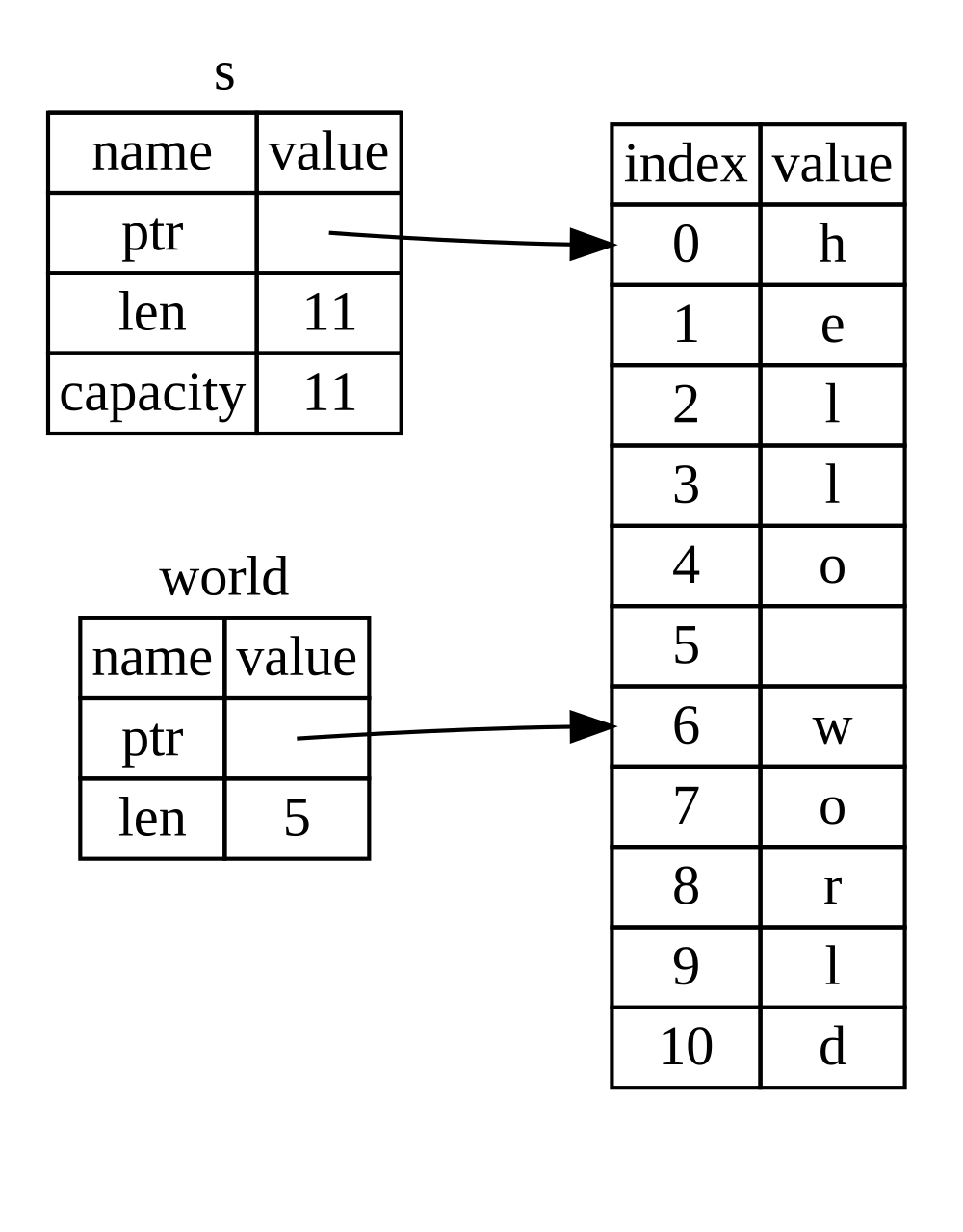
Recall that we talked about string literals being stored inside the binary. Now that we know about slices, we can properly understand string literals:
let s = "Hello, world!";`The type of s here is &str: it’s a slice pointing to that specific point of the binary. This is also why string literals are immutable; &str is an immutable reference.
Knowing that you can take slices of literals and String values leads us to one more improvement on first_word, and that’s its signature:
fn first_word(s: &String) -> &str {A more experienced Rustacean would write the signature shown in Listing 4-9 instead because it allows us to use the same function on both &String values and &str values.
fn first_word(s: &str) -> &str {If we have a string slice, we can pass that directly. If we have a String, we can pass a slice of the String or a reference to the String. This flexibility takes advantage of deref coercions, a feature we will cover in “Implicit Deref Coercions with Functions and Methods” section of Chapter 15.
Defining a function to take a string slice instead of a reference to a String makes our API more general and useful without losing any functionality:
fn first_word(s: &str) -> &str {
    let bytes = s.as_bytes();

    for (i, &item) in bytes.iter().enumerate() {
        if item == b' ' {
            return &s[0..i];
        }
    }

    &s[..]
}

fn main() {
    let my_string = String::from("hello world");

    // `first_word` works on slices of `String`s, whether partial or whole
    let word = first_word(&my_string[0..6]);
    let word = first_word(&my_string[..]);
    // `first_word` also works on references to `String`s, which are equivalent
    // to whole slices of `String`s
    let word = first_word(&my_string);

    let my_string_literal = "hello world";

    // `first_word` works on slices of string literals, whether partial or whole
    let word = first_word(&my_string_literal[0..6]);
    let word = first_word(&my_string_literal[..]);

    // Because string literals *are* string slices already,
    // this works too, without the slice syntax!
    let word = first_word(my_string_literal);
}
Other Slices
String slices, as you might imagine, are specific to strings. But there’s a more general slice type too. Consider this array:
let a = [1, 2, 3, 4, 5];
Just as we might want to refer to part of a string, we might want to refer to part of an array. We’d do so like this:
let a = [1, 2, 3, 4, 5]; let slice = &a[1..3]; assert_eq!(slice, &[2, 3]);
This slice has the type &[i32]. It works the same way as string slices do, by storing a reference to the first element and a length. You’ll use this kind of slice for all sorts of other collections. We’ll discuss these collections in detail when we talk about vectors in Chapter 8.